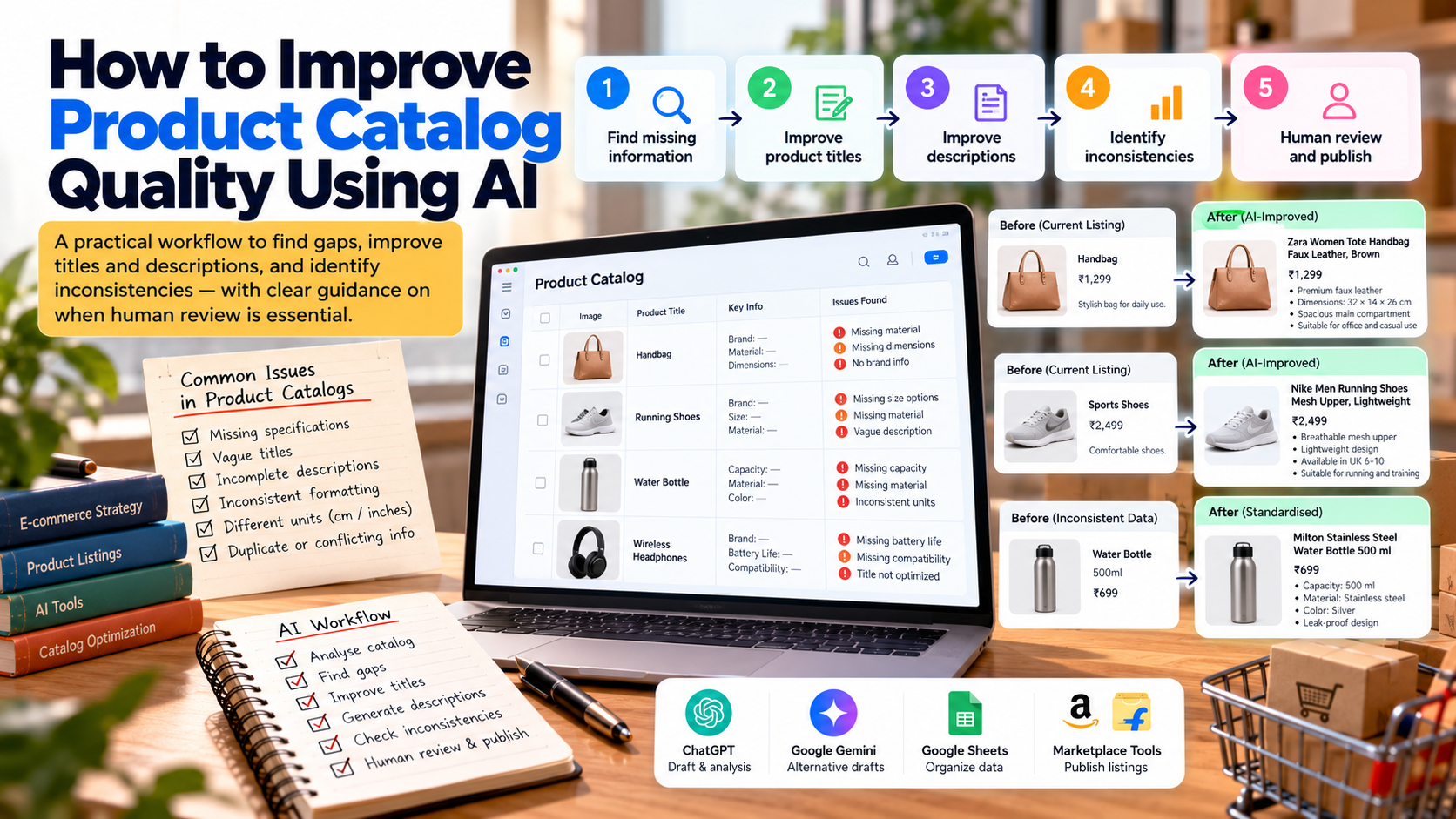
Product catalogs on marketplaces and online stores often suffer from the same problems: missing specifications, vague titles, inconsistent formatting, and descriptions that do not answer the questions buyers actually have. This guide shows how AI tools can help you find and fix these problems systematically — and where human review is always required.
Why catalog quality matters
Poor product listings cost sales in two ways. First, buyers cannot find products because the titles and descriptions do not match the terms they search for. Second, buyers who do find the product cannot make a confident purchase decision because key information is missing.
Improving catalog quality does not require rewriting every listing from scratch. It means finding the gaps and inconsistencies that matter most, then fixing them efficiently.
Step 1: Find missing product information
Start with a sample of your catalog — 20 to 50 products is enough to identify patterns. Export the data to a spreadsheet (CSV or Google Sheets) with one product per row and columns for title, description, specifications, and any other fields you use.
Paste a group of 5–10 product rows into an AI tool and use a prompt like this:
I am going to share product listings from an online store. For each product, identify what useful information seems to be missing that a buyer would likely want to know before purchasing. Focus on specifications, dimensions, compatibility, materials, and use cases. Do not add information that is not already present — only flag what is absent.
[Paste product data here]
Review the output. AI tools are good at spotting structural gaps (no dimensions listed, no material information, no compatibility notes). They are less reliable at knowing what is industry-specific or what your particular customers care about most.
Hypothetical example: If you sell phone cases and none of your listings specify whether the case is compatible with wireless charging, that is a high-impact gap an AI review would typically flag.
Step 2: Improve product titles
A product title should include the most important search terms a buyer would use, in the order buyers would use them. A common structure for marketplace listings is:
[Brand] + [Product Type] + [Key Specification] + [Model/Variant]
Example prompt:
Rewrite the following product titles to be clearer and more searchable. Keep each title under 80 characters. Include the product type, a key specification, and the brand name if present. Do not invent specifications that are not in the original title or description.
Current titles:
- "Blue Widget 2000"
- "Premium Gadget Case"
What to check: AI sometimes adds keywords that are plausible but not accurate for the specific product. Compare every revised title against the actual product specifications before publishing.
Step 3: Improve product descriptions
Good product descriptions answer the questions buyers ask most often. For physical products, these typically include:
- What is it made of?
- What are the dimensions or weight?
- What does it include in the box?
- What is it compatible with?
- What is the return or warranty policy?
Example prompt:
Rewrite the following product description to be clearer and more useful for a buyer. Use short paragraphs. Cover: what the product is, key specifications, what is included, and who it is suitable for. Do not add any claims not supported by the original description. Do not use marketing superlatives such as "best", "amazing", or "unbeatable".
Original description: [paste description]
The instruction to avoid unsupported claims is important. AI tools in persuasive writing mode tend to add positive superlatives that may not be accurate or permitted on some marketplaces.
Step 4: Identify inconsistencies across the catalog
Inconsistencies create a poor experience and can cause confusion in search results. Common examples:
- The same product is listed with different specifications across different variants.
- Units of measurement vary (cm in some listings, inches in others).
- Brand names are formatted differently across the catalog.
- Some listings have bullet-point features; others use paragraphs; others have neither.
Example prompt:
I am going to share 10 product listings. Identify any inconsistencies in formatting, units of measurement, terminology, or specification fields across the listings. List each inconsistency type with a brief example.
[Paste product listings]
Use the output to create a style guide for your catalog — a short document that defines your standard format, units, and terminology. Apply this guide when creating new listings.
Step 5: When human review is essential
AI tools should not publish product information autonomously. Human review is required whenever:
- Specifications are factual claims. A product weight, a compatibility statement, a material composition — these need to be verified against the actual product or manufacturer documentation, not inferred by AI.
- Regulatory or safety information is involved. Medical devices, food products, children's items, and electrical products often have mandatory disclosure requirements. AI cannot reliably identify or satisfy these requirements.
- Pricing and availability are derived from descriptions. AI-generated copy should never be used to set pricing or determine stock availability.
- The marketplace has content policies. Amazon, Flipkart, Meesho, and other platforms have specific rules about claims, restricted words, and required formats. A human familiar with the platform's policies should review all listing changes before publishing.
A realistic picture of time savings
The workflow above is not fully automated — it is AI-assisted. A realistic estimate for a business with 200 products:
| Task | Manual time | AI-assisted time |
|---|---|---|
| Gap analysis (per 50 products) | 4–6 hours | 1–2 hours (review only) |
| Title rewrites (per 50 products) | 3–5 hours | 1 hour (review and edit) |
| Description rewrites (per 50 products) | 8–12 hours | 2–3 hours (review and edit) |
These are rough estimates based on typical catalog workflows. Actual time savings depend on the current state of your catalog and how much review each product requires.
The main value of the AI-assisted approach is that it produces a structured first draft quickly, which is faster to review and edit than writing from scratch.
Tools for this workflow
| Tool | Use | Free? |
|---|---|---|
| ChatGPT | Draft generation, gap analysis | Yes (GPT-4o with limits) |
| Google Gemini | Alternative draft generation | Yes |
| Google Sheets | Data organisation and export | Yes |
| Marketplace seller tools | Publishing and listing management | Platform-dependent |
Next steps
Once you have improved your catalog quality, the next priority is usually tracking whether the changes affect sales or search visibility. Most marketplace platforms provide basic analytics showing impressions, click-through rates, and conversion rates per listing. Use these metrics to identify which improvements had the most impact and apply the same fixes to the rest of your catalog.